


Enterprises across the United States and Canada are reassessing how they manage voice and business communications. As organizations scale, support hybrid work, and operate across multiple locations, the discussion around VoiP vs traditional phone systems for enterprises has become unavoidable.
Legacy phone systems were built for centralized offices and static teams. Today, enterprises in healthcare, retail, hospitality, restaurants, hotels, logistics, and professional services need communication platforms that are flexible, scalable, and reliable across locations and devices.
This blog explores VoiP vs traditional phone systems for enterprises, explains the differences between VoIP, PBX, UCaaS, and cloud phone systems, and highlights how modern enterprises across North America are upgrading their communications.
Why Traditional Phone Systems No Longer Fit Enterprise Needs
When evaluating VoiP vs traditional phone systems for enterprises, traditional setups relying on on-premises PBX hardware and physical phone lines often present the first major limitations.
While these systems were dependable in the past, they introduce growing challenges for enterprises today.
Common limitations include:
- High maintenance and support costs for aging PBX hardware
- Expensive upgrades when adding users or opening new locations
- Limited support for remote and hybrid teams
- Single-site dependency and weak disaster recovery options
- Minimal insight into call performance and user activity
When comparing VoiP vs traditional phone systems for enterprises, the biggest drawback of legacy systems is rigidity. This becomes especially problematic for enterprises operating across cities like Toronto, Vancouver, Montreal, New York City, Chicago, and Seattle, where business environments are evolving quickly and communication systems must keep pace with rapid growth, remote workers, and modernization.

VoiP vs Traditional Phone Systems for Enterprises: What VoIP Changes
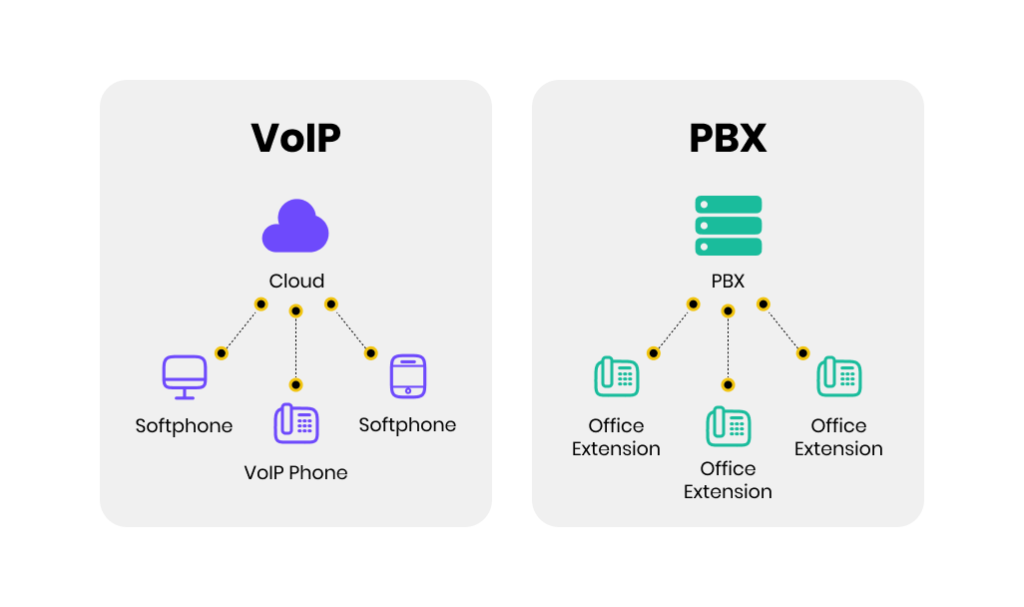
VoIP, or Voice over Internet Protocol, routes calls over the internet instead of traditional phone lines. This shift removes the dependency on physical infrastructure and allows enterprises to manage communications centrally.
With enterprise VoIP, organizations can:
- Use desk phones, laptops, and mobile devices under one business number
- Centralize call routing and administration across locations
- Support remote and hybrid employees without complex VPN setups
- Enable advanced features without installing new hardware
In the VoiP vs traditional phone systems for enterprises conversation, VoIP reflects a fundamental move away from static infrastructure toward communication systems designed to evolve with modern enterprises.
→ Are your teams still tied to desk phones or office-only extensions? Speak with a VoIP specialist about enterprise cloud phone options
PBX vs Cloud Phone Systems Explained
PBX systems were traditionally installed on site to manage extensions and external calls. Cloud phone systems modernize this model by hosting PBX functionality in secure data centers rather than server rooms.
Cloud phone systems allow enterprises to:
- Eliminate on-site PBX hardware
- Receive automatic updates and feature enhancements
- Scale users and locations quickly
- Manage call flows through a web-based portal
For most modern organizations, cloud phone systems replace the limitations of legacy PBX environments with greater flexibility, scalability, and operational efficiency.
What UCaaS Adds Beyond Basic VoIP
UCaaS, or Unified Communications as a Service, combines voice, video, messaging, and collaboration tools into one platform.
For enterprises, UCaaS delivers:
- One system for calls, meetings, and internal messaging
- Improved collaboration across departments and locations
- Fewer vendors and tools to manage
- A more consistent experience for customers and employees
Industries such as healthcare, retail, hospitality, restaurants, and hotels benefit from UCaaS by simplifying communication between frontline teams and back-office staff.
→ Is your enterprise juggling multiple tools for calling, meetings, and messaging? Request an enterprise phone system assessment
Why Enterprises in the U.S. and Canada Are Switching Now
Several trends are accelerating the move away from traditional phone systems.
Enterprises are switching because:
- Hybrid and remote work are now standard
- Customers expect faster and more reliable communication
- Traditional telecom contracts limit flexibility
- Cloud systems offer predictable monthly costs
- Multi-location operations require centralized control
In the context of VoiP vs traditional phone systems for enterprises, cloud-based communication aligns better with how organizations operate and talk to each other today.
Clear Clouds as a Modern Enterprise Solution
Clear Clouds by SE Telecom was designed to replace outdated PBX and landline systems with a modern cloud communication platform.
Clear Clouds provides enterprises with:
- Enterprise-grade VoIP and UCaaS capabilities
- Auto attendants, call routing, and voicemail-to-email
- Softphone access for desktop and mobile users
- Centralized management across multiple locations
- North American infrastructure and high availability
Clear Clouds supports enterprises across the United States and Canada with a flexible platform that scales as organizations grow.
→ Does data residency, uptime, or predictable pricing matter for your enterprise communications? Talk to SE Telecom about Canadian and U.S. enterprise VoIP solutions
VoiP vs Traditional Phone Systems for Enterprises: Cloud Alternatives
In the broader VoiP vs traditional phone systems for enterprises conversation, organizations often evaluate multiple enterprise-grade cloud platforms before fully moving away from traditional phone systems. While Clear Clouds is a strong fit for many enterprises, there are some other platforms enterprises can explore:
8×8 is commonly considered by enterprises that require analytics, contact center features, and global reach. It can work well for complex environments, though some organizations find contracts and pricing less flexible.
RingCentral is often evaluated by enterprises prioritizing third-party integrations and standardized workflows. Costs and licensing complexity can increase as deployments scale.
Microsoft Teams Phone is typically reviewed by enterprises already standardized on Microsoft 365. When deployed through SE Telecom’s Direct Routing, it can function as a full business phone system, though additional configuration and add-ons are often required to fully replace a traditional PBX.
Cisco Webex Calling is frequently used by large enterprises with existing Cisco infrastructure. It offers reliability and security but may be more complex than necessary for some organizations.
Cost Predictability for Enterprises
Cost remains a major factor when comparing VoiP vs traditional phone systems for enterprises. Legacy systems require capital investment, maintenance contracts, and periodic hardware upgrades.
Cloud phone systems shift communication to a predictable monthly model. Many enterprises adopt VoIP to reduce long-term costs while gaining flexibility and scalability without long-term lock-ins.
→ Are you comparing multiple enterprise cloud phone platforms right now? Compare enterprise cloud phone systems with a telecom expert

Migrating Without Disruption
One of the most common concerns enterprises have is downtime during migration. With proper planning, the transition to VoIP is structured and low risk.
A typical migration includes:
- Reviewing the existing phone environment
- Mapping call flows and business requirements
- Porting existing phone numbers
- Rolling out users and features in phases
- Training teams with minimal disruption
SE Telecom supports enterprises through every stage of this process.
VoiP vs Traditional Phone Systems for Enterprises: FAQs
Is VoIP suitable for enterprises operating across multiple cities?
In the context of VoiP vs traditional phone systems for enterprises, enterprises operating across cities such as Toronto, Vancouver, Montreal, New York City, Chicago, and Seattle use VoIP to centralize communication while maintaining local presence.
Can VoIP support regulated and compliance-focused industries?
Yes. Healthcare providers, financial services firms, government organizations, and professional services companies commonly use VoIP and UCaaS platforms that support encryption, access controls, and data residency requirements.
Is VoIP a good fit for hospitality, restaurants, and hotels?
Yes. These industries benefit from features like auto attendants, call routing, reservation call handling, and centralized management across multiple locations.
How does VoIP support retail and multi-location businesses?
Retail and franchise organizations use VoIP to manage calls centrally, route customers to the correct location, and support seasonal staff without deploying separate systems.
Can VoIP support hybrid and remote enterprise teams?
Yes. Employees can use the same business number on desk phones, laptops, and mobile devices, allowing enterprises to support flexible work without losing visibility or control.
Is VoIP reliable enough for high call volumes?
Modern enterprise VoIP platforms are built with redundancy and high availability, making them suitable for customer service, scheduling, reservations, and support teams handling large call volumes.
Final Thoughts on VoiP vs Traditional Phone Systems for Enterprises
The shift toward cloud communication reflects a broader reassessment of VoiP vs traditional phone systems for enterprises across the United States and Canada. Enterprises evaluating VoiP vs traditional phone systems for enterprises are choosing flexibility, scalability, and predictable costs over aging infrastructure.
Clear Clouds and other modern cloud platforms give enterprises the tools they need to support growth, mobility, and customer experience without the limitations of traditional PBX systems.
→ Ready to modernize how your enterprise communicates? Contact SE Telecom to plan your enterprise VoIP migration and get a quote today!
Follow SE Telecom on LinkedIn for more insights on VoIP, UCaaS, and enterprise communications.