


Not all telecom companies in Canada are built for Canadian businesses. The options available to a mid-market organization with 150 users across four locations, compliance obligations, and a hybrid workforce look very different from a residential internet bundle or a self-serve VoIP signup page – and yet many Canadian organizations end up evaluating both in the same breath.
This guide is written specifically for IT managers, operations leaders, and decision-makers at Canadian organizations looking to make a confident, informed decision when comparing telecom companies in Canada. It covers what to look for before you start evaluating, profiles eight providers worth knowing, and explains why the right choice depends far more on your operational requirements than on brand recognition.
→ Already know what you need and want to compare options? SE Telecom can put together a side-by-side set up and cost assessment for your organization – contact us today!

What Canadian Organizations Should Look for in Telecom Companies in Canada
Before comparing individual providers, it helps to establish what actually matters for a serious deployment. Telecom companies in Canada vary significantly across these dimensions and the ones that matter most depend on your organization’s size, industry, and operational complexity.
Scalability — can the platform grow with your organization without requiring a hardware overhaul, a new contract, or a full migration every time you add a location or expand your headcount? For organizations in growth mode, scalability is a non-negotiable.
Canadian data hosting and compliance — for organizations in healthcare, legal, financial services, and the public sector, where communication data is stored matters. Telecom companies in Canada that host data domestically eliminate the compliance risk that comes with U.S.-based infrastructure and U.S. data jurisdiction legislation like the CLOUD Act.
Contract flexibility — enterprise telecom contracts in Canada are often structured to benefit the carrier, not the customer. Auto-renewal clauses, minimum commitment thresholds, and long-term lock-ins are standard. For organizations whose operational requirements change, flexible terms are worth prioritizing.
Support quality and accountability — who answers when something goes wrong? Self-serve portals and offshore support centres are common among large carriers and global UCaaS platforms. Canadian-based support teams with real implementation experience are less common – and far more valuable when you actually need them.
Platform flexibility — does the provider push a single product, or do they evaluate your requirements and recommend what fits? Platform-agnostic providers give organizations access to the right tool rather than the most convenient one for the vendor.
Integration depth — modern Canadian organizations need their phone system to connect to Microsoft 365, CRM platforms, helpdesk tools, and analytics dashboards. Telecom companies in Canada that support deep integrations reduce operational friction and increase the return on the telecom investment.
8 Telecom Companies in Canada for Organizations
01 — SE Telecom
Website: setelecom.ca
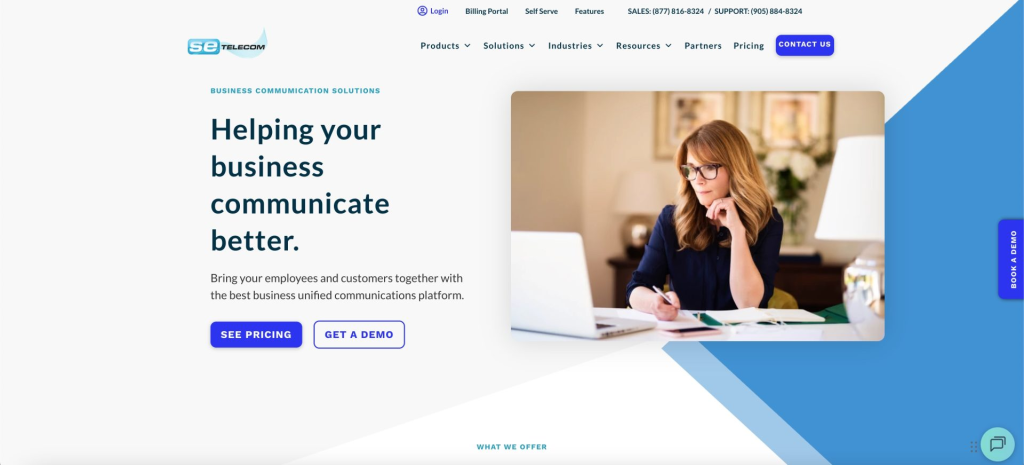
SE Telecom has supported mid-market and enterprise organizations across Canada and the United States with cloud phone systems and UCaaS platforms since 1999. Headquartered in Newmarket, Ontario, SE Telecom is platform-agnostic – evaluating each organization’s requirements and deploying the solution that fits, whether that’s Clear Clouds, RingCentral, or 8×8.
Clear Clouds is SE Telecom’s own Canadian-hosted VoIP and UCaaS platform, built for organizations that need enterprise-grade reliability, Canadian data residency, and predictable CAD pricing. SE Telecom also enables Microsoft Teams calling through Direct Routing and the Clear Clouds plugin – allowing organizations to use Teams as a full business phone system without Microsoft’s Calling Plans.
Strengths:
- Platform-agnostic deployment – Clear Clouds, RingCentral, 8×8, and Microsoft Direct Routing
- 100% Canadian-hosted infrastructure with full PIPEDA and PHIPA alignment
- No forced long-term contracts – month-to-month options available
- Real Canadian-based implementation support and ongoing service
- Custom call flow design, hybrid environments, and contact centre brokering
- CAD pricing – no USD billing exposure
- Available all throughout Canada and USA (data centers in both countries)
SE Telecom works with organizations across healthcare, legal, financial, and professional services, logistics, manufacturing, hospitality, and retail – industries where compliance, reliability, and support quality are non-negotiable.
→ Want to see how SE Telecom compares to your current provider? Contact SE Telecom for a no-commitment cost and equipment assessment – we will show you our pricing sheet!
02 — Bell Business
Website: bell.ca/business
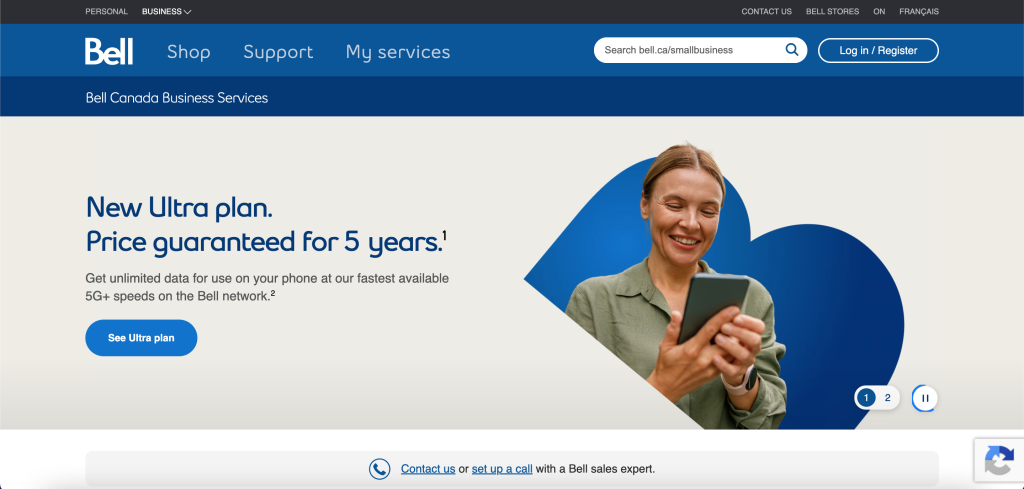
Bell Canada is the country’s largest telecommunications provider and offers a broad range of services including hosted PBX, SIP trunking, Microsoft Teams integration, and bundled connectivity packages. For large enterprises already integrated into Bell’s broader infrastructure, bundled offerings can simplify vendor management.
B2B strengths:
- National infrastructure coverage across Canada
- Broad enterprise service portfolio including voice, data, mobile, and managed services
- Microsoft Teams Phone integration available
- Strong presence in regulated industries including healthcare and financial services
Bell’s scale suits organizations that prioritize national coverage and bundled services. Organizations evaluating Bell should review contract terms, provisioning timelines, and support response commitments carefully.
03 — Rogers Business
Website: rogers.com/business
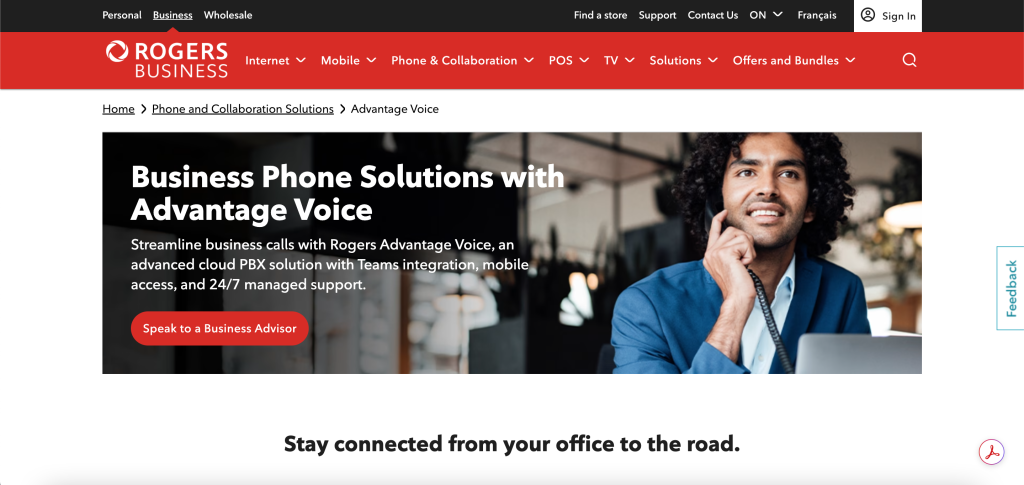
Rogers Business provides internet, VoIP, mobile, and unified communications services for Canadian businesses. Following the acquisition of Shaw Communications in 2023, Rogers significantly expanded its western Canadian footprint and now offers national coverage.
Strengths:
- National coverage across Canada including former Shaw territories in western Canada
- Bundled internet, voice, and mobile packages
- Business internet with strong reliability in major urban markets
- UCaaS and hosted voice options for mid-sized organizations
Rogers is commonly evaluated by organizations looking for a single provider for multiple telecom or IT services. Organizations with complex or custom voice requirements should confirm what level of call flow customization and support is available under their specific plan.
04 — TELUS Business
Website: telus.com/en/business
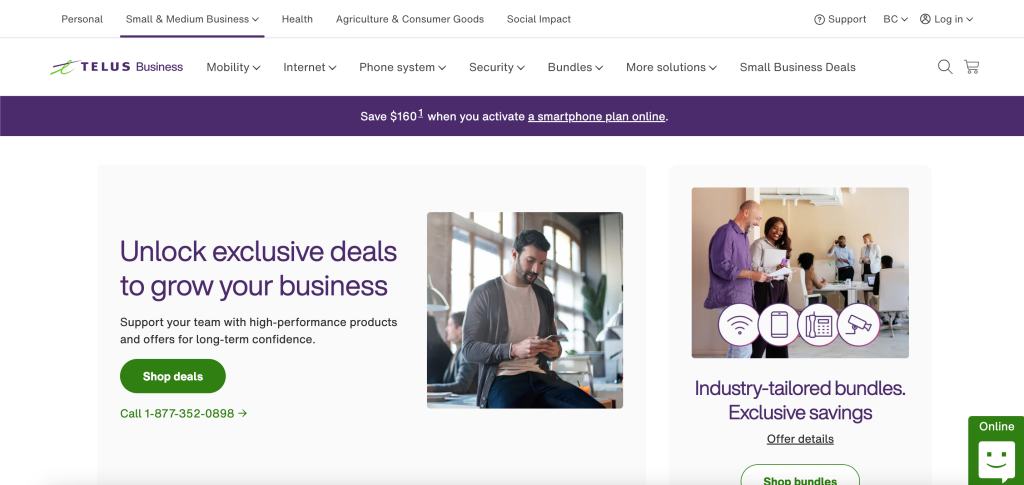
TELUS delivers mobile, internet, and UCaaS services across Canada with a particularly strong presence in British Columbia and Alberta. TELUS Business Connect offers cloud-based voice and collaboration tools designed for businesses modernizing their communications infrastructure.
B2B strengths:
- Strong mobile integration for organizations with field-based or distributed workforces
- TELUS Business Connect for cloud-based UCaaS
- Health-focused solutions for organizations operating in the Canadian healthcare sector
- National coverage with strong western Canadian infrastructure
TELUS is a strong fit for organizations prioritizing mobile-first telecommunications, particularly in western Canada. Organizations in Ontario and Quebec may find other providers offer more competitive pricing and support responsiveness in those markets.

06 — Comwave Business
Website: comwave.net/business
Comwave is Canada’s largest independent communications provider, headquartered in Toronto and serving over 1,600 cities across the country. Founded in 1999, Comwave serves the consumer, business, and wholesale markets through three geographically diverse Canadian data centres. Its portfolio includes hosted PBX, SIP trunking, business internet, and unified communications.
B2B strengths:
- Hosted PBX and SIP trunking for businesses of all sizes across Canada
- Bundled business internet and voice with redundancy built into the network
- Mobile app included – staff can make and receive calls from anywhere on the business number
- MPLS private network for organizations requiring secure multi-location connectivity
- Wholesale SIP trunking available for organizations or partners managing larger deployments
- Canadian-owned and operated with coast-to-coast coverage
Comwave is a practical option for Canadian organizations looking for a bundled voice and internet solution from an independent provider with broad national reach.
06 — Cogeco Business
Website: cogeco.ca/en/business
Cogeco provides internet, voice, and managed services for business customers primarily in Ontario and Quebec. With over 1.6 million residential and business subscribers across Canada and parts of the United States, Cogeco brings regional infrastructure depth to organizations operating in its service areas.
Strengths:
- Strong regional infrastructure in Ontario and Quebec markets
- Business phone lines, SIP trunking, and managed telephony services
- Bundled internet and voice packages for multi-location organizations
- Managed IT services for organizations looking to consolidate vendors
Cogeco is a practical option for organizations based in Ontario and Quebec that want a regional provider with established local infrastructure. Organizations requiring national coverage beyond Cogeco’s primary service areas should confirm coverage availability.
05 — ThinkTel
Website: thinktel.ca
ThinkTel is a division of Distributel Communications and one of Canada’s most established business-focused VoIP and SIP trunking providers, serving SMB and enterprise organizations coast to coast since 2003. With a CLEC voice network spanning over 1,200 cities and network points of presence in Toronto, Montreal, Edmonton, and Vancouver, ThinkTel is built specifically for business voice deployments – no residential products, no consumer bundles.
Strengths:
- Enterprise-grade SIP trunking with capacity-on-demand channel bursting
- Think365 Cloud Voice – Microsoft Teams Direct Routing with dedicated SIP trunks for PSTN connectivity
- Hosted PBX, contact centre, and unified communications services
- SureCall failover system with up to 8 simultaneous IP gateways for redundancy
- One national SIP trunk covering all Canadian locations – no separate trunks per city
- 100% business-focused – no channel conflict with consumer offerings
ThinkTel is a strong option for mid-market and enterprise organizations that need carrier-grade SIP trunking, Microsoft Teams voice integration, or a reliable Canadian CLEC as the foundation for their communications infrastructure.
08 — Beanfield
Website: beanfield.com
Beanfield is a Toronto-based telecommunications provider that owns and operates its own fiber-optic network, offering symmetrical internet speeds up to 8 Gbps for residential and business customers in Toronto, Montreal, Vancouver, and Ottawa. For Canadian organizations in Beanfield’s service footprint, the company offers a compelling alternative to the large national carriers – with no contracts and transparent pricing.
Strengths:
- Owns and operates its own fiber-optic network – no reliance on third-party infrastructure
- Symmetrical internet speeds up to 8 Gbps for bandwidth-intensive business environments
- No contracts – month-to-month terms as standard
- Strong reputation for customer service and transparent pricing
- Available in Toronto, Montreal, Vancouver, and Ottawa
Beanfield is worth evaluating for Canadian organizations in its service areas that need high-performance fiber connectivity and prefer straightforward terms over bundled packages.
National Carriers vs Independent Providers
One of the most consequential decisions when evaluating telecom companies in Canada for business use is choosing between a national carrier and an independent provider. Both have genuine strengths – and the right choice depends on what your organization actually needs.
National carriers — Bell, Rogers, and TELUS offer national infrastructure, broad service portfolios, and established enterprise relationships. For organizations that need bundled voice, data, and mobile under a single vendor, the national carriers offer a compelling package. Their scale also brings enterprise SLA commitments and dedicated account management for large contracts.
The tradeoffs are real, however. National carrier contracts are typically longer, less flexible, and harder to exit. Provisioning timelines for custom configurations can be slow. Support for complex or non-standard deployments is often inconsistent. And for organizations that need a consultative partner rather than a vendor relationship, the carrier model can feel impersonal and inflexible.
Independent providers — SE Telecom, ThinkTel, Comwave, Cogeco, and Beanfield each bring different regional strengths and business models. The best independent providers offer deeper consultation, more flexible terms, and in many cases better support responsiveness than a national carrier relationship at comparable scale.
For mid-market and enterprise Canadian organizations with complex requirements – multi-location deployments, hybrid environments, compliance obligations, or custom call flow needs – independent providers frequently deliver better outcomes than national carrier bundles designed for mass-market convenience.

What Industries Need From Telecom Companies in Canada
The right telecom partner looks different depending on the industry. Here’s what Canadian organizations in key Canadian sectors should prioritize when evaluating telecom companies in Canada:
Healthcare organizations — Canadian data hosting is non-negotiable. Patient communication data must remain in Canada under PHIPA and PIPEDA. Call queues, auto attendants, and uptime redundancy are operational requirements, not optional features. SE Telecom’s Clear Clouds platform is 100% Canadian-hosted and purpose-configured for healthcare environments.
Legal, financial, and professional services firms — call recording, access controls, voicemail-to-email, and compliance-grade reporting are standard requirements. These organizations also need providers that understand the sensitivity of client-facing communication and can configure platforms accordingly.
Logistics and manufacturing companies — mobile softphone access, intelligent call routing, and the ability to support field-based workforces are essential. Traditional desk-phone-only systems don’t fit how these organizations operate. Platforms that extend the business phone system to mobile devices without separate mobile plans are particularly valuable.
Hospitality and retail organizations — automated receptionists, departmental routing, and the ability to manage communication across multiple locations from a single platform are core requirements. Seasonal demand fluctuations make flexible, per-user pricing models significantly more attractive than minimum commitment contracts.
How to Evaluate Telecom Companies in Canada for Your Organization
Once you’ve identified the providers worth shortlisting, the evaluation process should cover these questions consistently across every provider:
01. Where is your data hosted? If the answer is the United States, and your Canadian organization operates in healthcare, legal, financial services, or the public sector, that’s a compliance risk worth understanding before you sign anything.
02. What are the contract terms? Ask specifically about minimum commitments, auto-renewal windows, and exit provisions. Many organizations discover these details after signing – not before.
03. What does implementation look like? Who handles number porting, call flow design, device provisioning, and staff training? Providers that manage this end-to-end reduce deployment risk significantly compared to self-serve models.
04. What happens when something goes wrong? Ask who you call, what the response SLA is, and where the support team is located. The answer matters more at 9am on a Monday morning than it does during a sales conversation.
05. Can you handle our specific requirements? If your organization has hybrid environments, custom call routing, contact centre needs, or cross-border operations, ask each provider explicitly whether they can accommodate that – and ask for examples.
06. What is the all-in cost in CAD? Get pricing in CAD, including setup, onboarding, add-ons, and any features that require a higher tier. USD billing from a provider that looks cheaper at the surface can erode that advantage quickly when the exchange rate moves.

Why SE Telecom Stands Out Among Telecom Companies in Canada
SE Telecom’s position among telecom companies in Canada is distinct – not because of infrastructure scale, but because of how the organization approaches business telecom deployments.
Most telecom companies in Canada give organizations one option and a contract to sign. SE Telecom starts with discovery – understanding the organization’s current infrastructure, operational requirements, compliance obligations, and growth plans before recommending anything.
That consultative approach leads to better outcomes because the recommendation is built around the organization, not around what’s easiest for SE Telecom to deploy. If Clear Clouds is the right fit, that’s what gets recommended. If RingCentral or 8×8 aligns better with the organization’s existing tools, SE Telecom deploys that. If the Microsoft Teams calling question is the central one, SE Telecom offers both Direct Routing and the Clear Clouds plugin – and explains the difference honestly.
What SE Telecom delivers consistently across every deployment:
- Clear Clouds — 100% Canadian-hosted VoIP and UCaaS platform, CAD pricing, no forced contracts
- Platform flexibility — RingCentral, 8×8, and Microsoft Direct Routing available alongside Clear Clouds
- Full implementation support — discovery, call flow design, number porting, device provisioning, training, and ongoing monitoring
- Canadian data hosting — PIPEDA and PHIPA aligned, all communication data stays in Canada
- Month-to-month options — no long-term lock-ins for organizations that need flexibility
- Real support — Canadian-based team, not a ticket portal or offshore call centre
- CAD pricing — no currency exposure, no USD billing surprises
For B2B organizations across healthcare, professional services, logistics, manufacturing, hospitality, and retail that are tired of being treated like a number in a carrier’s revenue forecast, SE Telecom offers something genuinely different: a telecom partner that acts like one.
→ Ready to compare telecom companies in Canada for your specific organization? SE Telecom will build a side-by-side assessment around your actual requirements – no pressure, no sales pitch, just a discovery discussion.
FAQ: Telecom Companies in Canada
What is the best telecom company in Canada for organizations? The right answer depends on your organization’s size, industry, location, and operational requirements. For mid-market and enterprise organizations that need Canadian data hosting, platform flexibility, compliance alignment, and real implementation support, SE Telecom consistently delivers outcomes that large national carriers and self-serve UCaaS platforms cannot match.
What is the difference between a national carrier and an independent telecom provider in Canada? National carriers like Bell, Rogers, and TELUS offer broad infrastructure and bundled services under long-term contracts. Independent providers like SE Telecom and Beanfield typically offer more flexible terms, more consultative deployments, and more responsive support for organizations with specific or complex requirements.
Do telecom companies in Canada store data in Canada? Not all of them. Large U.S.-based UCaaS platforms and some national carriers use U.S. data centres for parts of their cloud infrastructure. For regulated industries, this creates compliance risk. SE Telecom’s Clear Clouds platform is 100% Canadian-hosted – all communication data stays in Canada and remains aligned with PIPEDA and PHIPA.
Can telecom companies in Canada support multi-location organizations? Yes. Most modern hosted VoIP and UCaaS platforms support multi-location deployments from a single centralized dashboard. SE Telecom manages extensions, call routing, and reporting across multiple Canadian and U.S. locations without requiring separate systems at each site.
What should Canadian organizations ask telecom companies in Canada before signing a contract? Key questions include: where is data hosted, what are the contract terms and exit provisions, who handles implementation and support, can the platform support your specific requirements, and what is the all-in cost in CAD. Getting clear answers to all of these before signing eliminates the most common sources of post-deployment frustration.
Does SE Telecom serve Canadian organizations outside of Ontario? Yes. SE Telecom supports mid-market and enterprise organizations across Canada including British Columbia, Alberta, Quebec, and the Maritime provinces, as well as U.S. organizations requiring cross-border telecommunications infrastructure.
How long does it take to switch telecom companies in Canada? Most mid-market deployments through SE Telecom are completed in two to four weeks. Larger multi-location organizations with complex requirements are phased over four to eight weeks. SE Telecom manages the full process end-to-end – from discovery and number porting through to staff training and post-launch support.
→ Still have questions about telecom companies in Canada for your Canadian organization? SE Telecom is happy to help – reach out anytime.